
- September 16, 2026
- Posted by: Admin
- Category: Blogs
What Are ChatGPT Ads?
ChatGPT Ads are paid advertisements displayed within the ChatGPT experience, allowing brands to reach people while they are exploring options, asking questions and making decisions.
Unlike traditional search ads that are usually triggered by specific keywords, ChatGPT Ads can be relevant to the context of a user’s conversation. This creates a different advertising environment where the customer’s intent comes from what they are discussing, not just what they type into a search box.
For example, someone asking ChatGPT about:
- The best running shoes for beginners
- Software for managing a small business
- Hotels for a family holiday
- Marketing agencies for a growing brand
could potentially see relevant advertising alongside that conversation.
For businesses, this opens up another digital advertising opportunity: reaching customers while they are actively exploring a decision.
And that is what makes ChatGPT Ads interesting for marketers. The competition is no longer only about being visible when someone searches for something. It could increasingly be about being relevant when someone asks about it.
Yes. Since you’re writing this for a digital marketing audience, I’d add a practical section that explains what ChatGPT Ads look like, how a business can actually launch them, the current budget requirements, objectives, targeting and measurement.
Absolutely, poonam. I’d make it a fresh editorial blog, not a rewritten Help Centre article. The practical details can be included, but the writing should explain what this means for marketers and businesses, rather than simply listing OpenAI instructions.
One important update: OpenAI introduced a self serve Ads Manager beta in May 2026, with campaign budgeting, bidding, ad uploads and performance measurement available through the platform.
We Got ChatGPT Ads Before GTA 6
Some things take years to arrive.
GTA 6 is one of them.
ChatGPT Ads apparently wasn’t.
While the gaming world is still waiting for the next Grand Theft Auto, ChatGPT has already stepped into the advertising world, giving marketers a completely new place to think about reaching customers.
And the interesting part isn’t simply that ChatGPT now has ads.
It is where those ads appear and what kind of customer they can reach.
Traditional digital advertising has largely been built around two ideas.
You search for something, and you see an ad.
Or you scroll through a platform, and an ad finds you.
ChatGPT introduces a different environment.
- You are having a conversation.
- You are explaining what you need.
- You are comparing options.
- You are trying to make a decision.
- And that creates a very different opportunity for advertisers.
What Are ChatGPT Ads?
ChatGPT Ads are paid advertisements that appear within the ChatGPT experience, separate from the AI generated response.
OpenAI says ads are clearly labelled and kept visually separate from ChatGPT’s answers. The current advertising platform allows businesses to create campaigns, upload ads, set budgets and measure performance through Ads Manager.
The important difference is the environment.
Imagine someone asking:
What are the best running shoes for someone starting to train?
Instead of simply typing a keyword into a search engine, they are having a conversation about their needs.
That conversation can reveal much more context.
They might explain their budget, experience level, preferred use and what they are struggling with.
For marketers, this changes the question from:
What keyword should I target?
to:
What customer situation is relevant to my product?
And that is where ChatGPT Ads become interesting.
So, What Does a ChatGPT Ad Look Like?
The format is intentionally simple.
An ad can include the advertiser’s name, logo, headline, description, image and a destination link.
The ad appears as a sponsored element within the ChatGPT experience rather than being presented as part of ChatGPT’s answer. OpenAI’s advertising approach keeps commercial content distinct from the response itself.
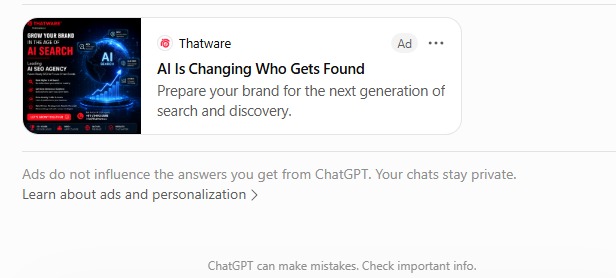
That distinction matters.
The idea isn’t to make users wonder whether the AI recommended something organically.
The ad is presented as an ad.
For brands, that means the creative itself needs to do the convincing.
How Can a Business Advertise on ChatGPT?
This is where things become more practical.
Businesses can access OpenAI Ads Manager, where they can create campaigns, set budgets and goals, upload creative and monitor performance. Chatgpt Ads is also working with advertising and technology partners for businesses that prefer buying through existing advertising ecosystems.
The basic journey looks like this:
Create an account → Set up a campaign → Choose your goal → Set budget and targeting → Create your ad → Add your landing page → Launch → Measure → Optimise
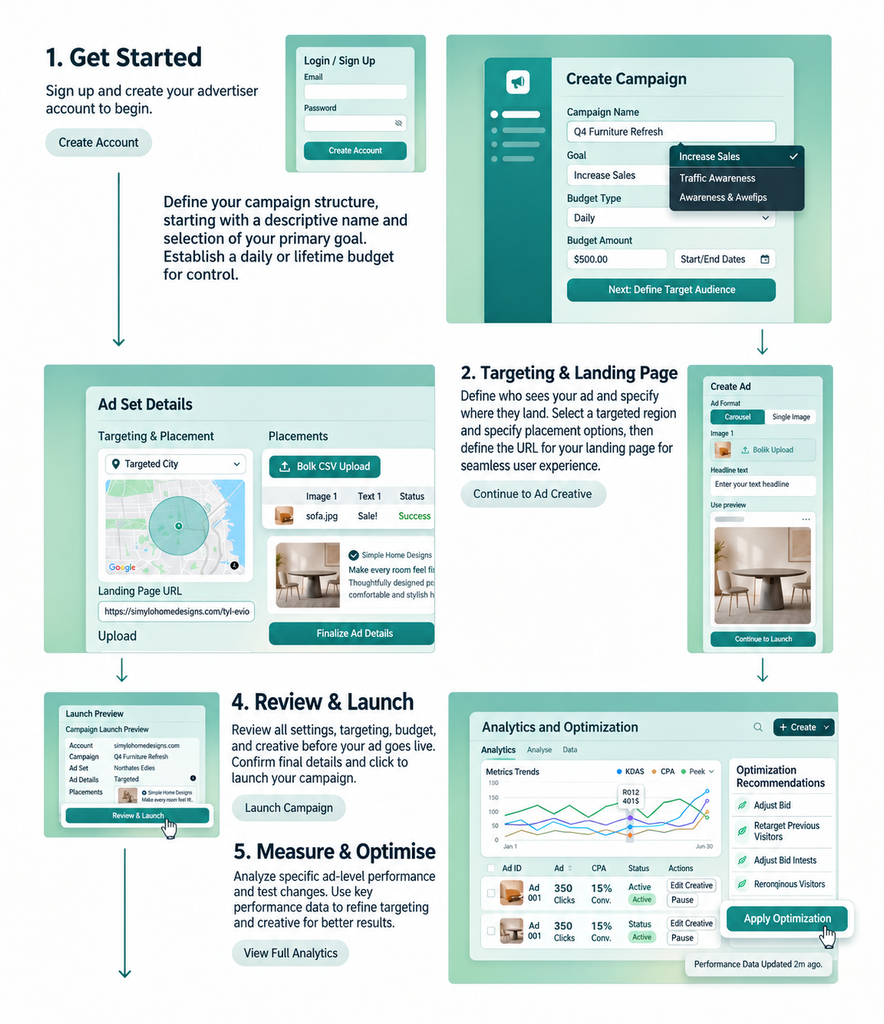
It is familiar to anyone who has worked with Google Ads or Meta Ads.
But the thinking behind the campaign is different.
What Can You Choose When Creating a Campaign?
A campaign starts with a business objective.
Depending on the current Ads Manager setup and market, advertisers can work with objectives such as reach, clicks and conversions.
That means a business could approach ChatGPT advertising for different reasons.
A new brand might want visibility.
An established business might want website traffic.
An ecommerce brand might care more about conversions.
The important thing is to decide the business outcome before deciding the creative.
An ad campaign should not begin with:
“What should our ad say?”
It should begin with:
“What do we want the customer to do?”
How Much Does It Cost to Advertise on ChatGPT?
This is one of the first questions businesses will ask.
OpenAI’s current Ads Manager has market specific minimums, so there isn’t one universal budget that applies everywhere.
For advertisers using the India market, the current daily budget minimum is ₹725.
But that number should not be confused with a recommended campaign budget.
A minimum budget simply tells you the smallest amount required to enter the auction.
It does not tell you how much you should spend to get meaningful results.
For a proper campaign test, marketers still need to consider:
- Business objective
- Audience and market
- Expected traffic
- Creative variations
- Conversion volume
- Landing page performance
- Testing period
- Cost per result
In other words, ₹725 may get a campaign running, but strategy determines whether the campaign is worth running.
What Objectives Are Available?
OpenAI’s current Ads Manager supports three campaign objectives:
| Objective | Pricing | Main purpose |
| CPM / Reach | Per 1,000 impressions | Awareness and visibility |
| CPC / Clicks | Per valid click | Traffic and engagement |
| oCPC | Per valid click | Optimising towards tracked conversions |
How Is ChatGPT Advertising Different From Google Ads?
This is perhaps the most interesting comparison.
Google Ads largely revolves around search intent.
Someone searches for something.
A relevant advertisement can appear.
ChatGPT creates an environment around conversational intent.
Someone explains what they are trying to solve.
- They ask follow up questions.
- They compare possibilities.
- They refine what they want.
- That creates a much richer picture of intent.
- Consider the difference.
A Google search might be:
Best project management software
A ChatGPT conversation might be:
I run a team of 15 people, we currently use spreadsheets, everyone keeps missing deadlines and I need something simple that won’t take weeks to set up.
The second contains far more context.
For advertisers, that could eventually mean a different way of thinking about relevance.
What Should Your ChatGPT Ad Look Like?
This is where marketers will need to rethink creative.
A generic headline such as:
Best Quality Products at Great Prices
doesn’t tell the customer much.
A more specific message can communicate:
Designed for first time runners who want everyday cushioning without a premium price.
The second message gives the customer a reason to care.
For ChatGPT Ads, brands should think about:
Specific problems
What is the customer trying to solve?
Clear benefits
What does your product actually help them do?
Relevant visuals
Does the image make sense for the product and message?
Strong landing pages
Does the page continue the same conversation started by the ad?
Multiple creative variations
Can you test different problems, benefits and messaging angles?
The goal isn’t simply to make an ad attractive.
It is to make it relevant.
What About Targeting?
This is another area where ChatGPT Ads can feel different from conventional advertising.
Instead of thinking only about demographic or interest categories, marketers need to think about contexts and customer needs.
For example, a travel company shouldn’t think only:
People interested in travel
It could think:
People planning a family holiday who are comparing destinations and looking for activities suitable for children.
A financial service brand might think:
People researching how to manage business finances while comparing accounting solutions.
The more clearly a business understands the problem it solves, the easier it becomes to build relevant advertising around that problem.
How Do You Measure Whether It Is Working?
Getting impressions is not the same as getting customers.
A proper campaign should be measured against its actual objective.
Depending on the campaign, marketers can look at metrics such as:
- Impressions
- Clicks
- Click-through rate
- Cost per click
- Cost per thousand impressions
- Conversions
- Conversion rate
- Spend
OpenAI’s Ads Manager also provides tools for campaign management and performance measurement.
And just like any other digital campaign, the real question comes after the click.
Did someone enquire?
Did they buy?
Did they sign up?
Did they become a qualified lead?
Because traffic is a metric. Business growth is the outcome.
What Should Marketers Prepare Before Testing ChatGPT Ads?
Before spending money, there are a few things worth getting right.
1. Know Your Customer Problem
Don’t start with the product.
Start with the problem your customer is trying to solve.
2. Prepare Multiple Creative Angles
Test different benefits, messages and visuals instead of putting everything behind one ad.
3. Fix Your Landing Page
If your ad promises one thing and the landing page talks about something else, the conversation breaks.
4. Set Up Conversion Tracking
Clicks tell you what happened before the website.
Conversions tell you what happened after.
5. Think Beyond Keywords
Start thinking about questions, problems, situations and decision-making moments.
6. Make Sure Your Website Can Be Reached
Your landing page needs to be accessible to the systems involved in delivering and measuring the advertising experience. OpenAI also has specific requirements around website access and advertising policies.
The Bigger Question: What Happens When People Ask Instead of Search?
This is the part marketers should really be watching.
Search engines changed advertising because people started searching online.
Social platforms changed advertising because people started spending time in feeds.
AI could change advertising because people are increasingly asking.
And asking is different from searching.
A search query can be three or four words.
A conversation can contain a person’s problem, preferences, budget, concerns and expectations.
That makes conversational intent an interesting new layer for digital marketing.
Should Your Business Start Advertising on ChatGPT?
There isn’t a universal answer.
The right question is whether your customers are likely to use AI conversations while researching the type of product or service you offer.
If they are, ChatGPT Ads could be worth testing as part of a broader digital strategy.
But the same principles still apply:
Have a clear objective.
Know your customer.
Create relevant messaging.
Track the outcome.
And optimise based on actual data.
Because a new advertising platform doesn’t automatically create better marketing.
The strategy still matters.
One More Important Point
At White Elephant Tech, this is exactly the kind of shift we keep an eye on. Digital marketing is not about following every new platform blindly. It is about understanding where customer behaviour is moving, testing what works and turning new opportunities into measurable marketing results.
ChatGPT Ads are currently a relatively new advertising channel, so businesses should treat early campaigns as testing and learning opportunities, rather than assuming that the platform will perform exactly like Google Ads or Meta Ads.
The mechanics are different.
The user behaviour is different.
And most importantly, the advertising environment is based around conversational intent rather than only search queries or audience interests.
That could make ChatGPT Ads one of the more interesting developments for digital marketers to watch.
And yes, we really got ChatGPT Ads before GTA 6.