
- August 4, 2025
- Posted by: Admin
- Category: Blogs
Introduction: The Rise of AI in Digital Marketing
In the last few years, AI in digital marketing has grown from a helpful assistant to a powerful driver of strategy. From writing ad copies and generating social media captions to creating entire campaign ideas, AI tools have made marketing faster, smarter, and often cheaper.
But here’s the question many marketers are quietly asking-
“Is AI taking over too much?”
While AI brings unmatched efficiency, it also raises concerns. Are we sacrificing creativity in the process? Are marketers relying too heavily on AI-generated ideas instead of developing original ones?
This blog dives deep into this concern, examining how AI in digital marketing is shaping creativity, where it enhances the process, and where it might hold us back. If you’re a content creator, marketer, or brand strategist wondering how to balance tech and imagination, this one’s for you.
What Makes Creativity So Important in Marketing?
Creativity is the heart of all memorable marketing. It’s what makes a brand stand out in a crowded feed, what connects emotionally with audiences, and what turns casual viewers into loyal customers. Think of the campaigns you still remember today; chances are, it’s not the tech behind them but the idea that stuck with you.
Even in today’s tech-driven world, human creativity adds the emotional intelligence, originality, and relatability that AI still struggles to match.
So, while AI in digital marketing can automate tasks and generate content, it can’t truly feel. It doesn’t know your audience’s mood, culture, or humour the way you do. And without that emotional connection, your marketing might be efficient, but not effective.
That’s why creativity isn’t just “nice to have”, it’s what transforms a campaign from forgettable to unforgettable.
Examples of AI in Digital Marketing (With a Twist of Wit!)
1. Chatbots: Your Digital Receptionist Who Never Sleeps
When you’re dreaming about your next big idea, your AI chatbot is busy handling queries, resolving complaints, and recommending the perfect product.
Think of it as a chai-sipping intern who never takes a break, except it answers faster.
Flipkart, Swiggy, and even your local service websites are already riding this bot wave!
2. Email Marketing: Cupid with a Processor
AI doesn’t just send emails, it knows when to slide into your inbox and what will make you click.
From personalised subject lines to “Hey, you left this in your cart 😏” reminders, AI ensures your email doesn’t end up in the spam folder of life.
Mailchimp, Zoho, and HubSpot are secretly in love with your audience, and they show it!
3. Ads that Stalk (but in a Loving Way)
Ever Googled “running shoes” and suddenly your Instagram becomes a sportswear showroom?
That’s AI whispering to your pixels.
Tools like Meta Advantage+ and Google Performance Max are like your nosy best friend; they know what you like and show it to you everywhere.
4. Content Creation: Pen to Processor
“Dear AI, write me a blog like Shakespeare and sound like a millennial.”
Done.
Whether it’s ChatGPT drafting your witty product descriptions or Jasper giving you tagline options, AI is the co-writer you didn’t know you hired.
But remember: AI writes the script, but human emotion gives it life.
5. Predictive Analytics: Fortune Teller, but with Graphs
“Your next customer will visit in 2 days. Be ready.”
Tools like Adobe Sensei and Salesforce Einstein don’t need tarot cards; they use data to predict user behaviour and tell you who’s ready to convert.
It’s like having your own digital astrologer who prefers dashboards over horoscopes.
6. Design Magic: AI Meets Aesthetics
Need a banner but have no designer?
AI tools like Canva’s Magic Resize, RunwayML, and DALL·E can cook up visuals, edit images, and even remove that awkward watermark, all before your chai cools down.
It’s like having an art student intern who never complains about revisions.
Can AI Really Replace Human Creativity?
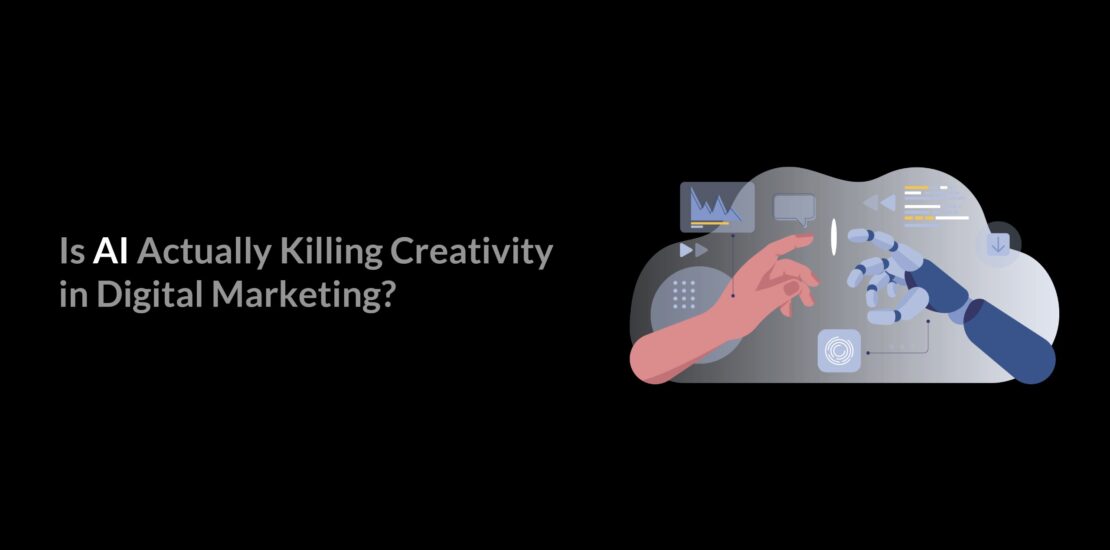
While AI in digital marketing is undeniably reshaping how we work, it is important to understand that AI should be seen as a powerful assistant, not a creative replacement. It streamlines processes, suggests ideas based on data, and speeds up production, but the emotional intelligence, lived experience, and cultural intuition that humans bring remain unmatched.
AI can write, design, and even edit, but it does so based on patterns it has already learned. It cannot feel the excitement behind a campaign idea, the fear behind a consumer insight, or the joy behind a design that truly connects. These are human elements, and they form the backbone of every campaign that moves people.
Rather than asking if AI will replace human creativity, the better question is, how can humans and AI create better together? When AI handles the heavy lifting, like data segmentation or keyword testing, humans get more time and energy to think deeper, dream bigger, and create freely.
In this sense, AI in digital marketing acts like an extended arm. It empowers professionals to make faster decisions, back up instincts with analytics, and execute at a scale never before possible. But the spark, the voice, and the connection still come from people. Just like a painter uses a brush or a writer uses a pen, marketers now use AI as a tool, not a substitute, to bring their ideas to life with even greater impact.
Why AI in Digital Marketing Isn’t the Enemy (If Used Right)?
AI in digital marketing is often misunderstood as a threat to originality. However, when used mindfully, it becomes a powerful tool to enhance creativity, not erase it. The key lies in knowing when to lean on AI for speed and support, and when to rely on human instincts for storytelling, emotional connection, and strategy.
Instead of seeing AI as a competitor, think of it as a collaborator. It gives structure to ideas, turns raw data into insights, and even helps test what works. But it can’t make decisions rooted in human emotion or cultural understanding. That’s still your superpower.
Used correctly, AI helps marketers focus more on strategy, originality, and experimentation, the very things that drive real creative success. It’s not the enemy; it’s the engine.
Also read: What is Generative Engine Optimisation (GEO)?
Tips to Keep Creativity Alive While Using AI
To strike the right balance between automation and innovation, here are some tips that ensure your creativity stays at the core while using AI in digital marketing:
1. Start with human ideas
Use AI to support, not start your creative process. Your insights and perspectives should lead the way.
2. Use AI for routine, not reasoning
Let AI handle repetitive tasks like A/B testing, scheduling, or keyword suggestions, while you focus on concept development and storytelling.
3. Add your voice back in
Even if AI drafts your captions or emails, always add a human voice and perspective before publishing.
4. Keep experimenting
AI gives you speed, so use that freedom to try new formats, campaign angles, or messaging ideas that push creative boundaries.
5. Don’t outsource empathy
AI can read patterns but not emotions. Keep the human touch alive by building messaging that reflects your audience’s real needs and feelings.
Final Thoughts: The Future of Creativity with AI in Digital Marketing
The future of digital marketing is not AI versus humans, it’s AI with humans. As tools become more advanced, our role as creative thinkers becomes even more important. AI in digital marketing can handle the “how,” but it still needs us for the “why.”
By working alongside AI, marketers can create more impactful campaigns, personalise at scale, and move faster than ever, without sacrificing originality. The challenge now is not whether AI will replace us, but how we evolve with it.
Because at the end of the day, creativity isn’t just about clever words or catchy visuals, it’s about making people feel something. And no matter how smart machines become, that emotional spark will always come from us.